29 Aug 2013

Words of wisdom - by John

I've been enjoying some proverbs again recently and so here are a few that have made me stop and think about how we do things here. Hopefully they will make you pause and ponder a bit too.


This is an interesting one. It's obviously not good to help people in need so that you get a reward, but the idea that we are 'lending' to God when we help people is quite an eye-opener.
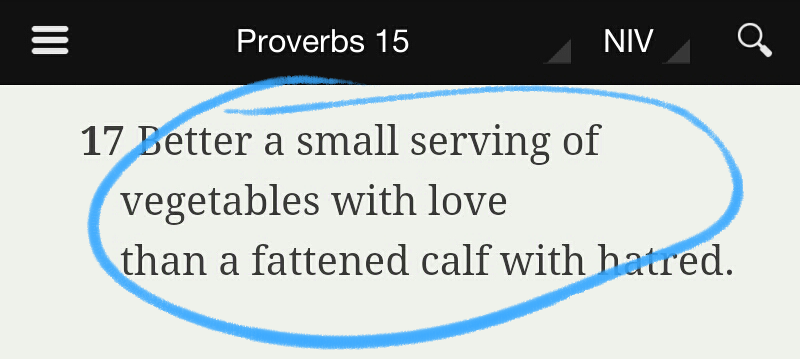


This one challenges my perceptions of development. We assume that it's all about having clean water, making money and improving conditions. Well, it is those things, but if there is no love in the heart or the household then aren't we missing the point?


Ok, seems obvious really. But this scary one reminds me that there are probably ways in which we all oppress the poor without realising it. Although it's not intentional that we buy products and services that oppress the poor through poor wages and conditions, we are still active in the system that exploits people. And I'm not sure if those who are oppressed really care whether we meant it or not, they just want it to stop.


Another development related one. How? Well it seems that many NGOs have the 'answer' to issues, problems and a communities' concerns well before they listen to the people they aim to help. It's so easy to do and, of course, you can only help in ways that you are skilled in. But I'm really keen to listen as much as possible before coming up with a list of answers to everyone's problems.

Hope there was a good slice of food for thought for you there too!

16 Aug 2013

Keeping clean - by John

Just a quick update here. It's been really busy with lots of visitors to the team on a 'Missions School'. I say visitors, but some are actually from the slum communities so we are their visitors really.
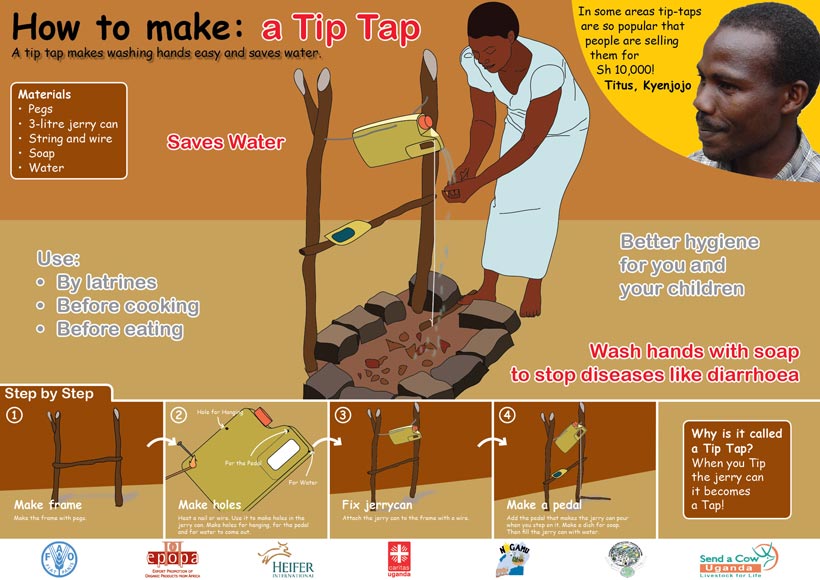
One of the things that we tried out with the team was making 'Tip-Tap' handwashers. These are made out of sticks, string and a bottle and so barely cost a thing but keep hands clean. The cleaner the hands, the less likely disease is to spread.

Here's one that our friend Charles helped to make in one of the slums. Part of the test is to see how long it lasts. It may be that the wood finds a new home in a fire and the bottle makes someone a nice water carrier - we'll wait and see!


You may notice that we have two posters on this toilet too. And if your eyesight is commando-like you'll see that one is in English and one Luganda. Part of the plan is to popularise techniques like this through posters etc. Maybe soon I'll be blogging about a giant Tip-Tap mural on this wall, that's if the tap itself stands up to pilfering hands.


5 Aug 2013

Half full or empty? - by John

As you may have picked up from previous blog posts, I am a big fan of seeing waste as a resource and focusing on opportunities rather than problems. With that approach I thought we should try out an idea in K1 in lieu of the bad floods which enter some of the houses at least once a year.

There is a lot on the internet about an interesting technology for building houses and water tanks through using plastic bottles as bricks. To make them strong like bricks, sand and soil are rammed into the bottles, which are stacked to make walls. Simple eh?


I thought we could try something out on a different scale by making use of the large bottles that are used by hotels and Muzungus (white folk) over here. They also find their way into the slums, but by that time you have to pay for them, although they are only about 12p a pop.

So, a few of us got together and set to work outside one mama's house, who gets filthy water flowing into it, to try this idea out. We also had help from the self-appointed 'Chairman', Obama, a fun chap who was trying to convince us that he fought in the First World War. He is old, but surely not? Mind you, he is also a witch doctor so you never know.

Here's how we got on.


We placed the bottles facing into the ground to hopefully prevent them from getting washed away (they are also very heavy!). Other, smaller bottles and stones were placed below and in the gaps between the large bottles.


A soil bank was piled up behind the bottles to help hold them in place as people walk across, compacting them over time. Obama is having a break here.. well, he is apparently over 100 years old ;)


Ta dah! The finished job looked good, but we will see how it fairs in the floods. We will be going into the community each week to see how it's doing. And to check if Obama has his letter from the Queen yet too.

15 Jul 2013

Rolex and hub caps - by John

A quick update with two new things from the past week:

#1

This video I made for schools about making a 'Rolex'. Not the time-keeper, this one is edible. Try it, they're tasty!


My new BBQ, made out of an old wheel hub. Proper Ugandan style!


That's all for now. Carry on as you were.

3 Jul 2013

Trial and error - by John

Before I start suggesting that people living in the slums try some techniques out, I want to try them out myself. 

So, my veranda and garden patch is slowly becoming a test bed for a few ideas to see if they work. I'm also very fortunate to be able to make videos for Send a Cow that are useful to them and me too. The solar tyre oven video below is an example of this. It may not be quite right for the slums, but the principles can be transferred to other materials.


The solar tyre oven works on the principle of reflection and a mini greenhouse effect. The glass costs about £5 and so is a bit too expensive for the people we are working with. So, I've tried out a smaller, cheaper (almost free) version that still works, just not as well (pic above). It's made out of a large water bottle, a little newspaper and silver foil. I cut the top off the bottle and inverted it and placed silver foil around this dish shape - this is where the black cooking pot sits. Then, I put the bottle base on top, creating a mini-greenhouse that heats food up, or even just generates hot water in the bottles to wash clothes with.

My other experiments involve growing plants in containers that you can get hold of in the slums. The idea is to keep the plants well fed with manure and 'plant tea' so that they do well in a small container. I'm also trying out growing an amazing tree called moringa (3 times the Potassium in bananas, 7 times the Vitamin-C as in oranges, 25 times the Iron in spinach, 4 times the Calcium in milk, 4 times the Vitamin A in carrots, 46 Antioxidants, 36 Anti-Inflammatories, Omegas 3, 6, and 9!) and an anti-malarial called artemesia that will both be very useful for the communities. Other than that, I'm drying out orange peels in the sun to use to light fires, and to repel mosquitoes. They burn really well due to their sugar content (thanks for the tip John and Sue Hill!) and are usually discarded and wasted in the slums. So, these are just a few things that I'm looking into during this research phase, as well as talking a lot with the community members and other NGOs.

I'll let you know how I get on!

19 Jun 2013

Hope and dreams in Banda slum - by John

A trip this morning to Banda made quite an impact on me. It was part of my series of trips into the communities to ask lots of questions and find out what their priorities are and what they want training in. Although I've got bags of ideas, I need them to tell me what they feel is important - at the moment anything to do with food growing, health and small business help is a winner.

See those containers next to the homes? Full of petrol!

After talking to several mamas <'mothers' in English> I got a real sense that each had a fairly well thought out dream for their lives, and some even a thorough business plan! I shouldn't be surprised as I'm a strong believer in the power and importance of dreams in our lives, I did my degree dissertation on the power of 'envisioning' a utopian future for our lives and society. I even put some stuff about dreams in our leaflet for coming to Uganda. But when you speak to people about how they want to sell charcoal at such-and-such a profit so that they can invest in a piece of land with goats and cows to farm and provide for their children it's really humbling. It's also hard not to act like a bank and offer to provide the capital they need right there and then, but more on that in another blog to come.

I think it reminded me of the importance of having vision in our own lives so that we go somewhere. Ironically, the word utopia is a play on words, meaning 'the nowhere place'. In other words, 'why dream of a perfect world, you know it won't happen.' But that is part of the point, it will only start to happen as we dream and have hope where there seems to be very little. I want to help these mamas kindle their dreams, and be careful not to fan too much expectation on them to begin with, but to help keep their dreams going and growing.

As I was thinking this walking around Banda, (yes, I do get myself into deep mode at times), an unexpected event happened that took me straight back to the here and now. A group of men, many holding gnarly sticks, ran angrily through where we were standing shouting and pointing into the distance. I'd heard of this happening - it was mob rule. They were after a man who had cheated and stolen money from them and they were getting fed up with it, so they took it into their own hands to finish him off, and yes, I do mean finish him off. The only hope for him was that someone had called the police. I was fully expecting to half watch this man being bludgeoned to death and was told there was nothing we could do as they were set on punishing him and people who interfere get the same.

Thankfully the police intervened.

It was all over so quickly. Mercifully, a policeman did come, and the mob strangely gave in to him straight away; perhaps the AK47 helped. The man was taken away to the station and it was over. Except that it wasn't. As we made our way over to the street, the mob was advancing again, now looking for the man's accomplices along with the police. The rest of the story? I don't know. They were angry and as I took this shot, they threatened me, so we thought it best to leave them to it.

What has this to do with the first half of this post? Well, after talking to my friends Bumba and Soloman, I learnt that this 20 something had been beaten to within an inch of his life many, many times before. Soloman had shared about the love of God with him several times, but he wasn't interested. This man had no dream, no hope. He knows at some point his nine lives will run out and the mob will get their justice. His only dreams are immediate; stealing and cheating people out of their money, despite the dire consequences. And although he fulfills his short-term dream time after time, he'll always come back for more until it's too late. But there is still hope for him yet.

So, what to make of all this? I'm not wholly sure. But I know that the power of what we dwell on in our minds, and dream about, has profound consequences. It has galvanised my intention to do my best to help people have a hope and to take steps towards their dreams. 

Let's see what happens. 

I'll also let you know what the end to the mob story was as soon as I can find out - I don't want to leave you in suspense...

*please leave a response using the boxes below :~)

17 Jun 2013

Getting into life in Uganda - by Sue

We've been here now for nearly three weeks and are feeling surprisingly at home. I've thrown myself into setting up home and helping the girls adjust to life here. I thought I may share some of the more minor details and differences of our life here, before I become so accustomed to them that they seem normal!


Our house here is lovely, a 2 bed bungalow with veranda, tiled floors, shower room, small but adequate kitchen, and a great view. We have finally finished unpacking and bought the things we need and our house definitely feels like home now. I'm getting used to the frequent power cuts, lack of water in the kitchen tap and no washing machine! And I am continually reminded of our blessings as I watch families living all around this area, walking to fetch water, sometimes children as young as two or three embarking on this job.

I love the walk to the local market stalls. Along a little path, goats often standing in our way, chickens pecking around, locals collecting water, men chopping down banana leaves with machetes and sometimes cows or other animals being led along. As we walk past some small settlements, children wave shouting 'bye, bye' or 'muzungu' which means white person! The women will be bent over a bowl washing clothes or dishes or sat by a cooking pot.

What stands out above all else is the friendliness of everyone you pass. The little stalls are all along the road, some with only a handful of veg and some with a lot. I fill my bag from various stalls with potatoes, avocados, tomatoes, buga (red leafy veg like spinach), mangos, a pineapple, green pepper, onions, garlic and am still likely to come home with change from the equivalent of £2. Mayah and Ava happily walk or skip along with me, waving to locals and acting as if this is no different than the UK!


On our last shopping trip when I took my eyes off them for only a moment and looked down to see them sat in the charcoal dust drawing pictures in it, with blackened faces, I thought maybe they had become too familiar with life here!

Even though it is warm all day, every day and all night, darkness falling at 7 (all year round) is taking some getting used too. This comes together with the mosquitos meaning that all doors and windows must be shut leaving us to the mercies of our electric fan! Even with everything shut, we can hear the crickets clearly!

Driving is the other main area that is so different to the UK. The rules of the road just don't seem to apply here. You have to just pull out whether something is coming or not and hope for the best. Little motorbikes called 'bodas' dart in and out of the traffic carrying the most interesting of loads; 3 people and a baby, 2 people and a pig, 2 people and a bed and almost any other combination you could imagine!


Despite many differences, as I mentioned earlier, I feel very at home here and am falling in love with beautiful Uganda and the beautiful people here. I hope this enlightens you a little into daily life here for us.

.