22 Sept 2013

Expect the Unexpected!


Before we moved to Uganda, when we were  just in the preparation stage, we were given a prophetic word from a friend that we should expect the unexpected. This has been true over and over again here. This has definitely been true of our journey into school life. Back at school in the UK, I remember a colleague asking me if I would get a teaching job in Uganda. I answered very strongly that no I wouldn't be and had no intention of working in a school. I also was fully expecting to be homeschooling the girls for at least the first year. Well things aren't always as you expect and I am now working in an international school (2 days a week) and the girls are attending the school 3 days a week.
It has been a beautiful journey and has God's blessing all over it! The first few months homeschooling went really well and the girls loved having so much time to play and enjoyed the schooling part, but it soon became obvious that they were desparate for friends of their own age and something more.  School fees for international schools here are really high so God seemed to have it all sorted that I could work for a couple of days at the school (which I love doing) in exchange for school fees. The school we found has just 60 kids in it from 3 - 11 and the largest class has only 15 children in it. In Ava's class of 12, there are 10 different nationalities, making it truly international. Mayah has settled in really well and loves her teacher and classmates and the small setting suits her down to the ground. It is such a joy to hear her chat so happily about school and to be so settled there. She even gets to do ballet as an after school club! Ava also loves school and participates in all activities with enthusiasm!. She has made some really strong friendships.


The other totally unexpected part of all this is my role in the school. I am overseeing the early years class (3 - 5's)! My experience in teaching has mainly been with 9-11 year olds. However, God's grace has totally been on me and I have really enjoyed this new challenge, especially having the opportunity to shape how the early years class operates. Working with an amazing Ugandan teacher and lovely Dutch lady has also been a joy.
Before we came, we felt really strongly that God would take good care of our children, that he wouldn't call us to work here and then abandon our girls. I am so excited to be able to testify to God's goodness that he really has taken care of the girls. It has been a journey with some homesickness and tears, but they have now developed strong friendships with 3 or 4 children each, are loving school, generally are enjoying life and will openly talk about how they are happy living here.
I am sure there will be many more trials to come but I trust God that he will continue to look after our girls and fill their lives with blessing.


18 Sept 2013

The must-have, miracle tree Moringa

Anyone who has spoken to me recently has probably heard me mention something about this special tree.

There's a lot that can be said about it, but to be brief, here are some pictures and a few words to give an idea as to why this tree now has a special place in my heart.

Let me introduce my personal (2 and a half month old) tree. They grow really quickly and in poor soils and as my mission is to replicate what is going on in the slums in mini-tests, this one is growing in a large water bottle. 


 So, what's so special about this tree? Well, there is almost too much to say. It has so many nutritional benefits, here are just a few:


It's used around the world and grows very well in the tropics - basically it grows in just about all of the countries where malnutrition is a problem. Handy eh? Also very handy is the fact that after doing some research and wanting to find a Moringa expert locally, it just so happens that one lives next door! He even helps publish book about the tree.

I'm not saying it definitely does all of the things below, but sometimes the wisdom of generations past can know best.


My plan is to trial growing Moringa in the slum communities, on roof tops in pots, in old jerry cans and water bottles. One great bloke called Fred is very keen on trying out some new ideas and so I'll be putting some pictures up soon of his home in the slum with pots on top and around the sides. I want to go slowly and carefully though, as the government tried to popularise Moringa a few years back and sold the idea as a get-rich-quick crop, but there was no market for it as people were not aware of it's many benefits. That's where we'll start - with telling people why it's so good.

If you want more info and a bit of hard evidence to back up some of these claims, try this site out.

Oh, and you can use the seeds to purify water too.....


29 Aug 2013

Words of wisdom - by John

I've been enjoying some proverbs again recently and so here are a few that have made me stop and think about how we do things here. Hopefully they will make you pause and ponder a bit too.


This is an interesting one. It's obviously not good to help people in need so that you get a reward, but the idea that we are 'lending' to God when we help people is quite an eye-opener.


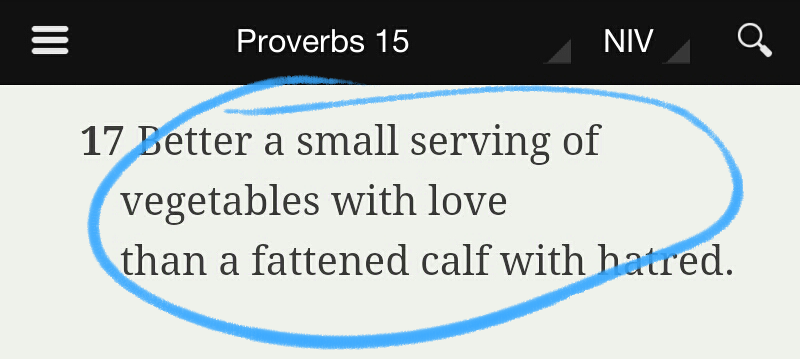
This one challenges my perceptions of development. We assume that it's all about having clean water, making money and improving conditions. Well, it is those things, but if there is no love in the heart or the household then aren't we missing the point?


Ok, seems obvious really. But this scary one reminds me that there are probably ways in which we all oppress the poor without realising it. Although it's not intentional that we buy products and services that oppress the poor through poor wages and conditions, we are still active in the system that exploits people. And I'm not sure if those who are oppressed really care whether we meant it or not, they just want it to stop.


Another development related one. How? Well it seems that many NGOs have the 'answer' to issues, problems and a communities' concerns well before they listen to the people they aim to help. It's so easy to do and, of course, you can only help in ways that you are skilled in. But I'm really keen to listen as much as possible before coming up with a list of answers to everyone's problems.

Hope there was a good slice of food for thought for you there too!

16 Aug 2013

Keeping clean - by John

Just a quick update here. It's been really busy with lots of visitors to the team on a 'Missions School'. I say visitors, but some are actually from the slum communities so we are their visitors really.
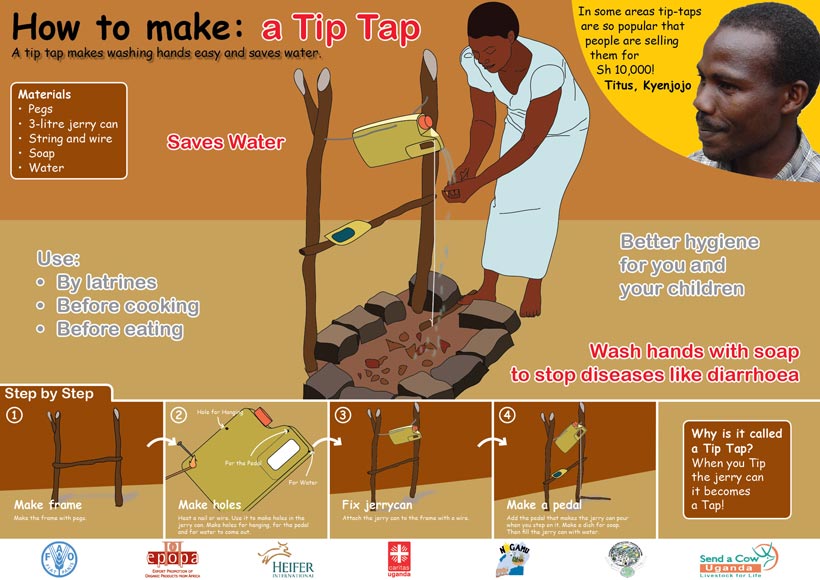
One of the things that we tried out with the team was making 'Tip-Tap' handwashers. These are made out of sticks, string and a bottle and so barely cost a thing but keep hands clean. The cleaner the hands, the less likely disease is to spread.

Here's one that our friend Charles helped to make in one of the slums. Part of the test is to see how long it lasts. It may be that the wood finds a new home in a fire and the bottle makes someone a nice water carrier - we'll wait and see!


You may notice that we have two posters on this toilet too. And if your eyesight is commando-like you'll see that one is in English and one Luganda. Part of the plan is to popularise techniques like this through posters etc. Maybe soon I'll be blogging about a giant Tip-Tap mural on this wall, that's if the tap itself stands up to pilfering hands.


5 Aug 2013

Half full or empty? - by John

As you may have picked up from previous blog posts, I am a big fan of seeing waste as a resource and focusing on opportunities rather than problems. With that approach I thought we should try out an idea in K1 in lieu of the bad floods which enter some of the houses at least once a year.

There is a lot on the internet about an interesting technology for building houses and water tanks through using plastic bottles as bricks. To make them strong like bricks, sand and soil are rammed into the bottles, which are stacked to make walls. Simple eh?


I thought we could try something out on a different scale by making use of the large bottles that are used by hotels and Muzungus (white folk) over here. They also find their way into the slums, but by that time you have to pay for them, although they are only about 12p a pop.

So, a few of us got together and set to work outside one mama's house, who gets filthy water flowing into it, to try this idea out. We also had help from the self-appointed 'Chairman', Obama, a fun chap who was trying to convince us that he fought in the First World War. He is old, but surely not? Mind you, he is also a witch doctor so you never know.

Here's how we got on.


We placed the bottles facing into the ground to hopefully prevent them from getting washed away (they are also very heavy!). Other, smaller bottles and stones were placed below and in the gaps between the large bottles.


A soil bank was piled up behind the bottles to help hold them in place as people walk across, compacting them over time. Obama is having a break here.. well, he is apparently over 100 years old ;)


Ta dah! The finished job looked good, but we will see how it fairs in the floods. We will be going into the community each week to see how it's doing. And to check if Obama has his letter from the Queen yet too.

15 Jul 2013

Rolex and hub caps - by John

A quick update with two new things from the past week:

#1

This video I made for schools about making a 'Rolex'. Not the time-keeper, this one is edible. Try it, they're tasty!


My new BBQ, made out of an old wheel hub. Proper Ugandan style!


That's all for now. Carry on as you were.

3 Jul 2013

Trial and error - by John

Before I start suggesting that people living in the slums try some techniques out, I want to try them out myself. 

So, my veranda and garden patch is slowly becoming a test bed for a few ideas to see if they work. I'm also very fortunate to be able to make videos for Send a Cow that are useful to them and me too. The solar tyre oven video below is an example of this. It may not be quite right for the slums, but the principles can be transferred to other materials.


The solar tyre oven works on the principle of reflection and a mini greenhouse effect. The glass costs about £5 and so is a bit too expensive for the people we are working with. So, I've tried out a smaller, cheaper (almost free) version that still works, just not as well (pic above). It's made out of a large water bottle, a little newspaper and silver foil. I cut the top off the bottle and inverted it and placed silver foil around this dish shape - this is where the black cooking pot sits. Then, I put the bottle base on top, creating a mini-greenhouse that heats food up, or even just generates hot water in the bottles to wash clothes with.

My other experiments involve growing plants in containers that you can get hold of in the slums. The idea is to keep the plants well fed with manure and 'plant tea' so that they do well in a small container. I'm also trying out growing an amazing tree called moringa (3 times the Potassium in bananas, 7 times the Vitamin-C as in oranges, 25 times the Iron in spinach, 4 times the Calcium in milk, 4 times the Vitamin A in carrots, 46 Antioxidants, 36 Anti-Inflammatories, Omegas 3, 6, and 9!) and an anti-malarial called artemesia that will both be very useful for the communities. Other than that, I'm drying out orange peels in the sun to use to light fires, and to repel mosquitoes. They burn really well due to their sugar content (thanks for the tip John and Sue Hill!) and are usually discarded and wasted in the slums. So, these are just a few things that I'm looking into during this research phase, as well as talking a lot with the community members and other NGOs.

I'll let you know how I get on!